
How can cities turn shared knowledge into climate solutions on the ground? At COP31 in Antalya, Türkiye, the Kaohsiung–ICLEI Climate Neutral and Smart Cities Community of Practice (ComP) showcased how collaboration among 15 international peer cities is helping bridge the gap between climate science, policy and implementation.
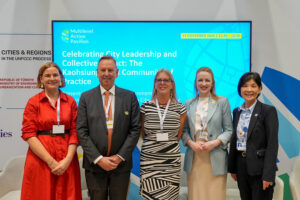
Held on 13 November at the Multilevel Action Pavilion, the session “Celebrating City Leadership and Collective Impact: The Kaohsiung–ICLEI Community of Practice” celebrated the achievements of this two-year initiative, which has brought together 15 cities and regions from East Asia, the Asia-Pacific and beyond to exchange knowledge, develop practical solutions and accelerate the transition toward climate-neutral and smart cities.
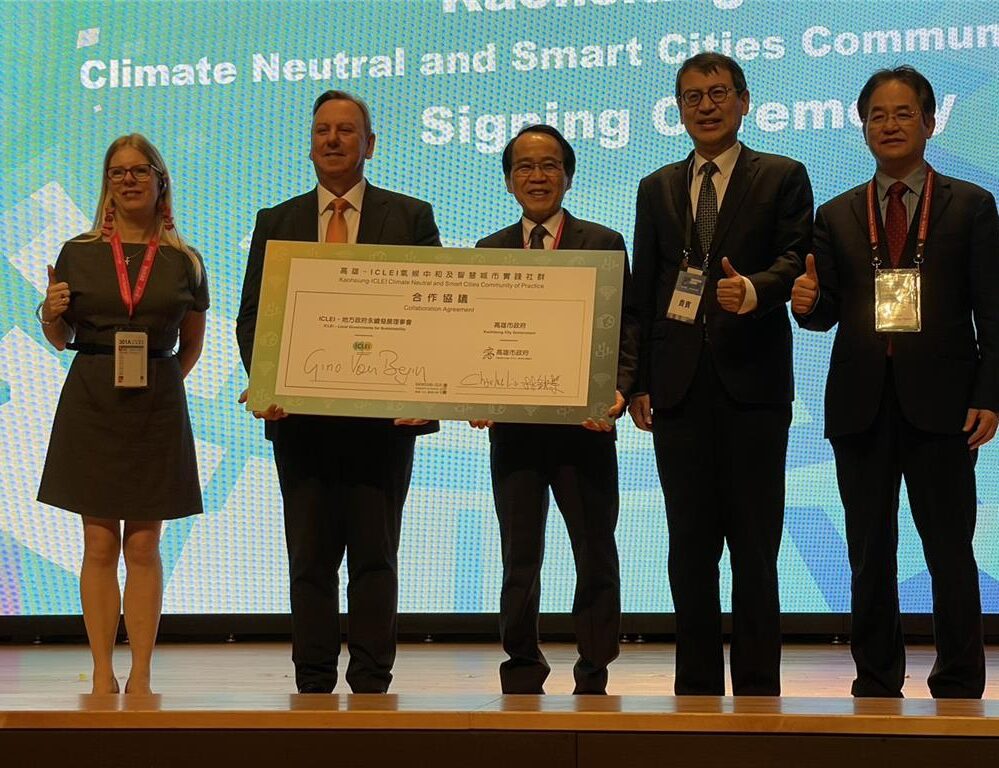
Chaired by the City of Kaohsiung and supported by the ICLEI World Secretariat and ICLEI Kaohsiung Capacity Center, the Community of Practice provides a platform for sustained collaboration among local governments, scientists and innovators, turning shared challenges into opportunities for collective action.
Reflecting on the partnership, ICLEI Secretary General Gino Van Begin, said: “Kaohsiung has been demonstrating extraordinary leadership, not only in providing the resources for this Community of Practice, but really in giving political attention to the issues discussed within it.”
Launched in 2024 under Kaohsiung’s leadership, the initiative has connected municipal decision-makers with scientists, international experts, and innovators through six thematic workshops covering circular development, urban innovation, sustainable mobility, innovative finance, sustainable energy, and AI-assisted climate transition planning.
Jui-Hun Chang, Director-General of Kaohsiung City’s Environmental Protection Bureau, emphasized: “Climate change affects us all. By learning from each other and working together, we can make a real difference.”
The session also spotlighted two knowledge products developed through the partnership. The ComP Good Practices Series shares practical experiences and lessons from participating cities, while the new six-part Kaohsiung Case Study Series documents the city’s approaches to climate-neutral and smart urban transformation. Together, these publications make local innovations and lessons accessible to cities worldwide.
For Newcastle, Australia, peer learning has already influenced local climate policy. Councillor Elizabeth Adamczyk, from Newcastle, Australia, explained how the Flourishing Lives 4 All approach and the Expanded Climate and Innovation Agenda informed the development of the city’s Mission Possible: Climate Action Plan 2026–2030, which includes 77 actions toward net-zero council operations.
Reflecting on the value of these exchanges, she emphasized: “Where you can talk honestly about what worked, what didn’t and why, you can turn best practice into next practice.”
The importance of connecting scientific knowledge with municipal decision-making was another central theme. Professor Diana Ürge-Vorsatz, IPCC Vice-Chair, highlighted the role of city-science partnerships in translating evidence into action: “Knowledge does not turn into implementation by itself. Cities need to translate this evidence into choices about housing, transport, public spaces, urban planning, energy solutions, finance and public services.”
Simone Sandholz, Head of the FAST Division at the United Nations University Institute for Environment and Human Security (UNU-EHS), emphasized the importance of trust, collaboration and openness to learning: “Cities do best when they’re doing it together, and when they’re also willing to learn from each other, which also takes some courage.”
The session reinforced a central lesson from the initiative: Cities can accelerate climate action by learning from one another, connecting science with local realities, and turning shared knowledge into solutions that improve people’s lives.
 News